A first-order PDE in $n$ variables is an equation of the form:
\begin{align*}
F(\nabla u(x), u(x), x) = 0, \quad x \in \Omega,
\end{align*}
where $\Omega \subseteq \mathbb{R}^n$ is open and $u: \Omega \to \mathbb{R}$ is the unknown. The [function](/page/Function) $F: \mathbb{R}^n \times \mathbb{R} \times \mathbb{R}^n \to \mathbb{R}$ encodes the equation, with arguments written as $F(a, b, c)$ where $a \in \mathbb{R}^n$ is the gradient slot, $b \in \mathbb{R}$ the value slot, and $c \in \mathbb{R}^n$ the position slot. Equations of this type include the linear transport equation, the fully nonlinear eikonal equation $|\nabla u|^2 = 1$, and the Hamilton-Jacobi equations of classical mechanics.
The **method of characteristics** converts this PDE into a system of ODEs along special curves called characteristics. The core idea is simple: for a smooth solution $u$, define curves $X(s)$ in $\Omega$ and track the quantities $U(s) = u(X(s))$ and $G(s) = \nabla u(X(s))$ along them. If the curve velocity $\dot{X}$ is chosen to equal $\nabla_a F$ evaluated at the current state, then the evolution of $G$, $U$, and $X$ closes into a self-contained first-order ODE system — one that involves no undetermined [derivatives](/page/Derivative) of $u$. Solving this ODE system from [boundary](/page/Boundary) data then constructs the solution.
The simplest illustration: for the transport equation $u_t + b \cdot \nabla_x u = 0$, we have $F(a, b, c) = a_{n+1} + b' \cdot a'$ and $\nabla_a F = (b', 1)$, so characteristics are the straight lines $(x_0 + sb, s)$. Along each line $U(s) = u(x_0 + sb, s)$ satisfies $\dot{U} = 0$, so $u$ is constant and the solution is simply $u(x,t) = g(x - bt)$. The entire theory extends this picture to the nonlinear setting.
## The Characteristic ODE System
Throughout, we consider the boundary value problem of finding $u \in C^2(\Omega)$ satisfying:
\begin{align*}
F(\nabla u(x), u(x), x) &= 0, && x \in \Omega, \\
u(x) &= g(x), && x \in \Gamma,
\end{align*}
where $F$ is smooth and $\Gamma \subseteq \partial\Omega$ is the portion of the boundary where data is prescribed. We assume throughout that $F$ is smooth and $g \in C^2(\Gamma)$.
[quotetheorem:49]
The key observation is that the choice $\dot{X}_j = \partial F/\partial a_j$ is precisely what allows the second-order information $\partial^2 u/\partial x_i \partial x_j$ to cancel in the derivation: differentiating the PDE with respect to $x_i$ produces a term $\sum_j F_{a_j} \partial_{ij}^2 u$, which is exactly $\dot{G}_i$. The resulting ODE system involves only $G$, $U$, $X$ and the known function $F$ — no derivatives of $u$ beyond those already tracked.
[definition: Characteristic Curve]
Given a smooth function $F: \mathbb{R}^n \times \mathbb{R} \times \mathbb{R}^n \to \mathbb{R}$, a **characteristic curve** is a triple of smooth maps:
\begin{align*}
(G, U, X): A &\to \mathbb{R}^n \times \mathbb{R} \times \mathbb{R}^n \\
s &\mapsto (G(s), U(s), X(s))
\end{align*}
defined on an interval $A \subseteq \mathbb{R}$, satisfying the characteristic ODE system of Theorem 49. We call $T(s) := (G(s), U(s), X(s))$ the **characteristic triple** and $s \mapsto X(s)$ the **spatial characteristic**. The velocity $\dot{X}(s) = \nabla_a F|_{T(s)}$ is the **characteristic velocity**.
[/definition]
[remark: F Is Constant Along Characteristics]
If $u$ is a $C^2$ solution and $(G,U,X)$ is the associated characteristic triple, then $F(T(s)) = 0$ for all $s$ — not just at the starting point. To see this, differentiate $F(G(s), U(s), X(s))$ in $s$ and substitute the three ODE equations:
\begin{align*}
\frac{d}{ds}F(G(s), U(s), X(s)) &= \sum_i \frac{\partial F}{\partial a_i}\dot{G}_i + \frac{\partial F}{\partial b}\dot{U} + \sum_j \frac{\partial F}{\partial c_j}\dot{X}_j \\
&= \sum_i \frac{\partial F}{\partial a_i}\!\left(-\frac{\partial F}{\partial c_i} - G_i \frac{\partial F}{\partial b}\right) + \frac{\partial F}{\partial b}\sum_j G_j \frac{\partial F}{\partial a_j} + \sum_j \frac{\partial F}{\partial c_j}\frac{\partial F}{\partial a_j} = 0.
\end{align*}
The three [groups](/page/Group) cancel pairwise. This is the mechanism by which the PDE is encoded in the ODE: the constraint $F = 0$ is preserved automatically along the flow.
[/remark]
## Initial Data and Compatibility
To launch a characteristic from a boundary point $\tilde{c} \in \Gamma$, we need initial data $(G(0), U(0), X(0))$. Setting $X(0) = \tilde{c}$ and $U(0) = g(\tilde{c})$ is immediate. The initial gradient $G(0) = \nabla u(\tilde{c})$ is more subtle: since $g$ is only defined on $\Gamma$, it determines the tangential part of $\nabla u|_\Gamma$, but the normal component is a priori unknown. It is constrained by two conditions.
[definition: Admissible Triple]
A triple $(\tilde{a}, \tilde{b}, \tilde{c})$ with $\tilde{a} \in \mathbb{R}^n$, $\tilde{b} \in \mathbb{R}$, $\tilde{c} \in \Gamma$ is called **admissible** if:
\begin{align*}
\tilde{b} &= g(\tilde{c}), \\
F(\tilde{a}, \tilde{b}, \tilde{c}) &= 0, \\
\tilde{a} \cdot \tau &= \nabla_\Gamma g(\tilde{c}) \cdot \tau \quad \text{for every vector } \tau \text{ tangent to } \Gamma \text{ at } \tilde{c}.
\end{align*}
The three conditions are value consistency, PDE consistency, and tangential consistency respectively.
[/definition]
Tangential consistency is necessary: any $C^1$ extension of $g$ into $\Omega$ must have tangential derivatives at $\Gamma$ matching those of $g$ on $\Gamma$. This pins the tangential components of $\tilde{a}$ completely. The normal component of $\tilde{a}$ then remains as the single degree of freedom, to be determined by the PDE constraint $F(\tilde{a}, \tilde{b}, \tilde{c}) = 0$.
[definition: Non-Characteristic Boundary]
An admissible triple $(\tilde{a}, \tilde{b}, \tilde{c})$ satisfies the **non-characteristic condition** at $\tilde{c} \in \Gamma$ if:
\begin{align*}
\nabla_a F(\tilde{a}, \tilde{b}, \tilde{c}) \cdot \nu(\tilde{c}) \neq 0,
\end{align*}
where $\nu(\tilde{c})$ is the outward unit normal to $\Gamma$ at $\tilde{c}$.
[/definition]
Geometrically, $\nabla_a F|_{T(0)} = \dot{X}(0)$ is the initial characteristic velocity. The condition $\nabla_a F \cdot \nu \neq 0$ says this velocity has a non-zero component pointing into the domain: the characteristics issued from $\tilde{c}$ are transversal to $\Gamma$ and genuinely enter $\Omega$. If the condition fails, the characteristics graze along $\Gamma$ and cannot cover a neighbourhood of $\tilde{c}$ in $\Omega$.
The non-characteristic condition is also precisely what ensures the PDE constraint $F(\tilde{a}, \tilde{b}, \tilde{c}) = 0$ can be uniquely solved for the normal component of $\tilde{a}$: by the [implicit function theorem](/page/Implicit%20Function%20Theorem), the derivative of $F$ in the normal direction is $\nabla_a F \cdot \nu \neq 0$, so the normal component is a smooth function of the tangential components and the base point $\tilde{c}$.
## Local Existence
With admissible initial data and the non-characteristic condition, the characteristic flow map is a local diffeomorphism, and the solution can be read off from it.
[quotetheorem:231]
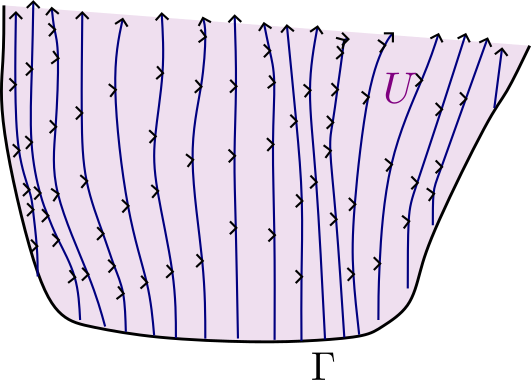
The strategy is to launch characteristics from all $c_0$ in a neighbourhood $\Gamma' \subseteq \Gamma$ of $\tilde{c}$, producing a two-parameter family of solutions $X(s, c_0)$ to the ODE system. The flow map $\Psi(s, c_0) = X(s, c_0)$ is a local diffeomorphism by the non-characteristic condition: its Jacobian at $(0, \tilde{c})$ has columns $\dot{X}(0) = \nabla_a F$ (transversal to $\Gamma$) and the tangent vectors to $\Gamma$ (spanning the boundary), which are linearly independent. The solution is then $u(x) = U(\Psi^{-1}(x))$.
{width=35%}
## Breakdown of Classical Solutions
The local existence theorem is sharp: it guarantees a solution only in a neighbourhood of $\tilde{c}$, and global classical solutions may fail to exist. Two mechanisms cause breakdown.
If two characteristics issuing from distinct boundary points $c_0 \neq c_0'$ meet at some interior point $x^*$, then $u(x^*)$ would need to take two generally different values — an impossibility for a function. The flow map $\Psi$ fails to be injective and the classical solution ceases to exist at $x^*$. The solution beyond this time must be interpreted as a **weak solution** (typically a shock), which requires an entropy condition to select the physical one. This is explored on the [Entropy Condition](/pages/1022) page.
If the Jacobian of $\Psi$ vanishes along a characteristic — that is, $\det(D\Psi) = 0$ — then the flow map ceases to be a local diffeomorphism and $|\nabla u| \to \infty$ along that curve, a **gradient catastrophe** or caustic. The geometry of such singularities is studied on the [Envelope of Shocks](/pages/1029) page.
## Examples
### Linear Transport Equation
[example: Linear Transport Equation]
Consider:
\begin{align*}
u_t(x,t) + b \cdot \nabla_x u(x,t) &= 0, \quad (x,t) \in \mathbb{R}^n \times (0,\infty), \\
u(x,0) &= g(x), \quad x \in \mathbb{R}^n,
\end{align*}
with $b \in \mathbb{R}^n$ fixed and $g \in C^1(\mathbb{R}^n)$. Writing the full spatial variable as $(x,t) \in \mathbb{R}^{n+1}$, this fits the framework with $F(a, \tilde{b}, \tilde{c}) = a_{n+1} + \sum_{k=1}^n b_k a_k$, where $a = (a_1,\dots,a_{n+1})$ encodes the full gradient $(u_x, u_t)$.
**Characteristic equations.** Writing the full variable as $(x_1, \dots, x_{n+1}) = (x, t)$, the partial derivatives of $F$ are $\partial F / \partial a_k = b_k$ for $k \le n$, $\partial F / \partial a_{n+1} = 1$, $\partial F / \partial \tilde{b} = 0$, and $\partial F / \partial \tilde{c}_i = 0$. The general characteristic system gives:
\begin{align*}
\dot{X}^k(s) &= \frac{\partial F}{\partial a_k}\bigg|_{T(s)} = b_k, \quad k = 1, \dots, n, \\
\dot{X}^{n+1}(s) &= \frac{\partial F}{\partial a_{n+1}}\bigg|_{T(s)} = 1, \\
\dot{G}^i(s) &= -\frac{\partial F}{\partial \tilde{c}_i}\bigg|_{T(s)} - G^i(s)\frac{\partial F}{\partial \tilde{b}}\bigg|_{T(s)} = 0, \quad i = 1, \dots, n+1, \\
\dot{U}(s) &= \sum_{j=1}^{n+1} G^j(s)\frac{\partial F}{\partial a_j}\bigg|_{T(s)} = \sum_{k=1}^{n} G^k(s)\,b_k + G^{n+1}(s).
\end{align*}
Since $F$ is preserved along characteristics and $F(T(s)) = G^{n+1}(s) + \sum_{k=1}^n b_k\,G^k(s) = 0$, we obtain $\dot{U}(s) = 0$.
**Solving the ODE system.** We launch a characteristic from the boundary point $x_0 \in \mathbb{R}^n$ at $t = 0$, so the initial data are $X^k(0) = (x_0)_k$ for $k = 1, \dots, n$, $X^{n+1}(0) = 0$, and $U(0) = g(x_0)$. Integrating each ODE in turn:
From $\dot{U}(s) = 0$:
\begin{align*}
U(s) = U(0) = g(x_0) \quad \text{for all } s.
\end{align*}
From $\dot{X}^k(s) = b_k$ for $k = 1, \dots, n$:
\begin{align*}
X^k(s) = (x_0)_k + s\,b_k.
\end{align*}
From $\dot{X}^{n+1}(s) = 1$:
\begin{align*}
X^{n+1}(s) = s.
\end{align*}
The characteristics are parallel straight lines in $(x,t)$-space with common velocity $(b, 1)$, independent of $x_0$.
**Extracting a candidate solution.** By definition, $U(s) = u(X^1(s), \dots, X^{n+1}(s))$. Substituting the expressions above:
\begin{align*}
u(x_0 + sb,\; s) = g(x_0) \quad \text{for all } s.
\end{align*}
Writing $x = (X^1(s), \dots, X^n(s)) = x_0 + sb$ and $t = X^{n+1}(s) = s$, we solve for $x_0 = x - tb$. This suggests the candidate solution:
\begin{align*}
u(x,t) = g(x - tb).
\end{align*}
One verifies directly that $u_t + b \cdot \nabla_x u = -b \cdot \nabla g + b \cdot \nabla g = 0$ and $u(x,0) = g(x)$, confirming that this is indeed the solution.
Since all characteristics have the same velocity $(b,1)$, they are parallel and never cross. The solution is as smooth as $g$ and exists globally for all $t > 0$.
[/example]
### Burgers' Equation and Shock Formation
[example: Burgers Equation]
Inviscid Burgers' equation on $\mathbb{R} \times (0,\infty)$:
\begin{align*}
u_t(x,t) + u(x,t)\,u_x(x,t) &= 0, \quad (x,t) \in \mathbb{R} \times (0,\infty), \\
u(x,0) &= g(x), \quad x \in \mathbb{R},
\end{align*}
with $g \in C^1(\mathbb{R})$. This is quasilinear: $F(a, b, c) = a_t + b \cdot a_x$, so the characteristic velocity $\nabla_a F = (b, 1) = (U(s), 1)$ depends on the solution value.
**Characteristic equations.** Writing $(x_1, x_2) = (x, t)$ so that $n = 2$, the partial derivatives of $F$ are $\partial F / \partial a_1 = b$, $\partial F / \partial a_2 = 1$, $\partial F / \partial b = a_1$, and $\partial F / \partial c_i = 0$. The general characteristic system gives:
\begin{align*}
\dot{X}^1(s) &= \frac{\partial F}{\partial a_1}\bigg|_{T(s)} = U(s), \\
\dot{X}^2(s) &= \frac{\partial F}{\partial a_2}\bigg|_{T(s)} = 1, \\
\dot{G}^1(s) &= -\frac{\partial F}{\partial c_1}\bigg|_{T(s)} - G^1(s)\frac{\partial F}{\partial b}\bigg|_{T(s)} = -(G^1(s))^2, \\
\dot{G}^2(s) &= -\frac{\partial F}{\partial c_2}\bigg|_{T(s)} - G^2(s)\frac{\partial F}{\partial b}\bigg|_{T(s)} = -G^2(s)\,G^1(s), \\
\dot{U}(s) &= \sum_{j=1}^{2} G^j(s)\frac{\partial F}{\partial a_j}\bigg|_{T(s)} = G^1(s)\,U(s) + G^2(s).
\end{align*}
Since $F$ is preserved along characteristics (see the remark above) and $F(T(0)) = 0$, we have $G^2(s) + U(s)\,G^1(s) = 0$ for all $s$, and therefore $\dot{U}(s) = G^1(s)\,U(s) + G^2(s) = 0$.
**Solving the ODE system.** We launch a characteristic from the boundary point $x_0 \in \mathbb{R}$ at $t = 0$, so the initial data are $X^1(0) = x_0$, $X^2(0) = 0$, and $U(0) = g(x_0)$. Integrating each ODE in turn:
From $\dot{U}(s) = 0$:
\begin{align*}
U(s) = U(0) = g(x_0) \quad \text{for all } s.
\end{align*}
Substituting into $\dot{X}^1(s) = U(s) = g(x_0)$, which is now constant:
\begin{align*}
X^1(s) = X^1(0) + s\,g(x_0) = x_0 + s\,g(x_0).
\end{align*}
From $\dot{X}^2(s) = 1$:
\begin{align*}
X^2(s) = X^2(0) + s = s.
\end{align*}
The characteristics are straight lines in $(x,t)$-space, but their slopes depend on the starting point $x_0$ through the initial value $g(x_0)$.
**Extracting a candidate solution.** By definition, $U(s) = u(X^1(s), X^2(s))$. Substituting the expressions above:
\begin{align*}
u\bigl(x_0 + s\,g(x_0),\; s\bigr) = g(x_0) \quad \text{for all } s.
\end{align*}
Writing $x = X^1(s) = x_0 + s\,g(x_0)$ and $t = X^2(s) = s$, we can solve for $x_0 = x - t\,g(x_0)$. Since $g(x_0) = u(x,t)$, this gives $x_0 = x - t\,u(x,t)$, and therefore:
\begin{align*}
u(x,t) = g\bigl(x - t\,u(x,t)\bigr).
\end{align*}
This is an implicit relation that the solution must satisfy. At this stage, it is a *candidate*: we have shown that any $C^2$ solution must satisfy it, but we have not yet proved existence. There are two ways to proceed:
1. **Via the general theory.** The local existence theorem guarantees that the flow map $\Phi_t(x_0) = x_0 + t\,g(x_0)$ is a local diffeomorphism near any $x_0$ where the non-characteristic condition holds ($\Phi_t'(x_0) = 1 + t\,g'(x_0) \neq 0$), so the candidate is indeed the unique local solution.
2. **By direct verification.** Differentiating the implicit relation $u = g(x - tu)$ with respect to $t$ and $x$, one obtains $u_t + u\,u_x = 0$ directly, confirming that the candidate solves the PDE wherever $\Phi_t$ is invertible.
**The flow map.** Recovering $x_0$ from $(x,t)$ amounts to inverting:
\begin{align*}
\Phi_t: \mathbb{R} &\to \mathbb{R} \\
x_0 &\mapsto x_0 + t\,g(x_0).
\end{align*}
The Jacobian is $\Phi_t'(x_0) = 1 + t\,g'(x_0)$. By the [inverse function theorem](/page/Inverse%20Function%20Theorem), $\Phi_t$ is a local diffeomorphism wherever $\Phi_t'(x_0) \neq 0$, and the solution $u$ is $C^1$ in a neighbourhood of the corresponding point $(x,t)$.
**Why $g' < 0$ causes characteristic crossing.** The characteristic from $x_0$ travels at speed $g(x_0)$, so characteristics from different starting points travel at different speeds. If $x_0 < x_0'$ and $g(x_0) > g(x_0')$ — that is, $g$ is decreasing between $x_0$ and $x_0'$ — then the left characteristic moves faster than the right one. At time $t$, their positions are:
\begin{align*}
X(t; x_0) = x_0 + t\,g(x_0), \quad X(t; x_0') = x_0' + t\,g(x_0').
\end{align*}
Initially ($t = 0$) the gap is $X(0; x_0') - X(0; x_0) = x_0' - x_0 > 0$, but the gap shrinks at rate $g(x_0') - g(x_0) < 0$. Setting $X(t; x_0) = X(t; x_0')$ and solving gives the crossing time:
\begin{align*}
t_{\mathrm{cross}} = \frac{x_0' - x_0}{g(x_0) - g(x_0')}.
\end{align*}
By the [mean value theorem](/theorems/186), $g(x_0) - g(x_0') = -g'(\xi)(x_0' - x_0)$ for some $\xi \in (x_0, x_0')$, so $t_{\mathrm{cross}} = 1/(-g'(\xi))$. Taking the infimum over all such pairs, the earliest possible crossing time is:
\begin{align*}
T^* = \frac{1}{\displaystyle\max_{x_0 \in \mathbb{R}}(-g'(x_0))}.
\end{align*}
**Why characteristic crossing destroys the classical solution.** At the crossing point $(x^*, T^*)$, two characteristics arriving from distinct starting points $x_0 \neq x_0'$ meet. Each carries its own solution value: the first carries $g(x_0)$, the second carries $g(x_0')$. Since $g$ is strictly decreasing between $x_0$ and $x_0'$, these values are distinct, and $u(x^*, T^*)$ would need to take two different values simultaneously — impossible for a single-valued function.
From the perspective of the flow map, the Jacobian $\Phi_{T^*}'(x_0) = 1 + T^*g'(x_0)$ vanishes at the point $x_0$ where $-g'$ attains its maximum. This means $\Phi_{T^*}$ ceases to be a local diffeomorphism: the inverse $\Phi_{T^*}^{-1}$ does not exist smoothly near the crossing point, so we cannot recover $x_0$ from $x$ and the formula $u(x,t) = g(\Phi_t^{-1}(x))$ breaks down. Differentiating the implicit relation $u = g(x - tu)$ with respect to $x$ gives:
\begin{align*}
u_x = \frac{g'(x_0)}{1 + t\,g'(x_0)},
\end{align*}
which diverges as $1 + tg'(x_0) \to 0$: a **gradient catastrophe** where $|u_x| \to \infty$.
**After breakdown: weak solutions and entropy.** For $t > T^*$, the classical $C^1$ solution ceases to exist. The solution continues as a **weak solution** — a bounded measurable function satisfying the PDE in the [distributional](/page/Distribution) sense — which admits a discontinuity (a **shock**) along a curve in the $(x,t)$-plane. The shock speed is determined by the Rankine–Hugoniot condition, and a unique physically relevant solution is selected by an **entropy condition** (see the [Entropy Condition](/pages/1022) page).
**Example.** Take $g(x) = \sin x$. Then $g'(x) = \cos x$, so $\max(-g') = 1$ and the classical solution breaks down at $T^* = 1$. For $t < 1$ the solution is given implicitly by $u(x,t) = \sin(x - t\,u(x,t))$.
[/example]
### Eikonal Equation
[example: Eikonal Equation]
The eikonal equation models wavefront propagation in a homogeneous medium:
\begin{align*}
|\nabla u(x)|^2 &= 1, \quad x \in \Omega \subseteq \mathbb{R}^n, \\
u(x) &= 0, \quad x \in \Gamma,
\end{align*}
where $\Gamma \subseteq \partial\Omega$ is the initial wavefront. This is fully nonlinear: $F(a, b, c) = |a|^2 - 1$.
**Characteristic equations.** The partial derivatives of $F$ are $\partial F / \partial a_i = 2a_i$, $\partial F / \partial b = 0$, and $\partial F / \partial c_j = 0$. The general characteristic system gives:
\begin{align*}
\dot{X}^j(s) &= \frac{\partial F}{\partial a_j}\bigg|_{T(s)} = 2G^j(s), \quad j = 1, \dots, n, \\
\dot{G}^i(s) &= -\frac{\partial F}{\partial c_i}\bigg|_{T(s)} - G^i(s)\frac{\partial F}{\partial b}\bigg|_{T(s)} = 0, \quad i = 1, \dots, n, \\
\dot{U}(s) &= \sum_{j=1}^{n} G^j(s)\frac{\partial F}{\partial a_j}\bigg|_{T(s)} = 2|G(s)|^2.
\end{align*}
**Initial data.** At a boundary point $\tilde{c} \in \Gamma$, the admissibility conditions require $U(0) = g(\tilde{c}) = 0$, $F(G(0), 0, \tilde{c}) = |G(0)|^2 - 1 = 0$, and $G(0) \cdot \tau = 0$ for all $\tau$ tangent to $\Gamma$ (since $g = 0$ on $\Gamma$, all tangential derivatives of $g$ vanish). The tangential consistency condition forces $G(0)$ to be normal to $\Gamma$, and $|G(0)| = 1$ forces it to be the inward unit normal $G(0) = -\nu(\tilde{c})$ (choosing the sign so characteristics enter $\Omega$).
The non-characteristic condition: $\nabla_a F \cdot \nu = 2G(0) \cdot \nu = -2 \neq 0$. ✓
**Solving the ODE system.** We launch a characteristic from a boundary point $\tilde{c} \in \Gamma$ with initial data $X^j(0) = \tilde{c}_j$ for $j = 1, \dots, n$, $U(0) = 0$, and $G^i(0) = -\nu_i(\tilde{c})$. Integrating each ODE in turn:
From $\dot{G}^i(s) = 0$:
\begin{align*}
G^i(s) = G^i(0) = -\nu_i(\tilde{c}) \quad \text{for all } s.
\end{align*}
Substituting into $\dot{X}^j(s) = 2G^j(s) = -2\nu_j(\tilde{c})$, which is now constant:
\begin{align*}
X^j(s) = \tilde{c}_j - 2s\,\nu_j(\tilde{c}).
\end{align*}
From $\dot{U}(s) = 2|G(s)|^2 = 2$:
\begin{align*}
U(s) = U(0) + 2s = 2s.
\end{align*}
**Extracting a candidate solution.** By definition, $U(s) = u(X^1(s), \dots, X^n(s))$. Substituting the expressions above:
\begin{align*}
u(\tilde{c} - 2s\,\nu(\tilde{c})) = 2s \quad \text{for all } s.
\end{align*}
The point $x = \tilde{c} - 2s\,\nu(\tilde{c})$ lies at distance $|x - \tilde{c}| = 2s$ from $\tilde{c}$ (since $|\nu| = 1$), directed along the inward normal. Writing the arc-length parameter $r = 2s$ gives $x = \tilde{c} + r\,\nu_{\mathrm{in}}(\tilde{c})$ and $u(x) = r$, so the candidate solution is:
\begin{align*}
u(x) = \mathrm{dist}(x, \Gamma),
\end{align*}
the distance function to $\Gamma$. The characteristics are straight rays shot inward from $\Gamma$ along the inward unit normal. The solution is smooth as long as these rays do not cross, which is guaranteed when $\Gamma$ is convex. When $\Gamma$ is non-convex, the rays from different points of $\Gamma$ meet at the **medial axis** of $\Omega$, beyond which the distance function loses smoothness (though it remains Lipschitz and satisfies the eikonal equation almost everywhere as a viscosity solution).
[/example]
## References
1. L. C. Evans, *Partial Differential Equations*, 2nd ed., AMS (2010). §3.2.
2. F. John, *Partial Differential Equations*, 4th ed., Springer (1982). Ch. 1.
3. M. E. Taylor, *Partial Differential Equations I*, Springer (1996). §1.1.
